
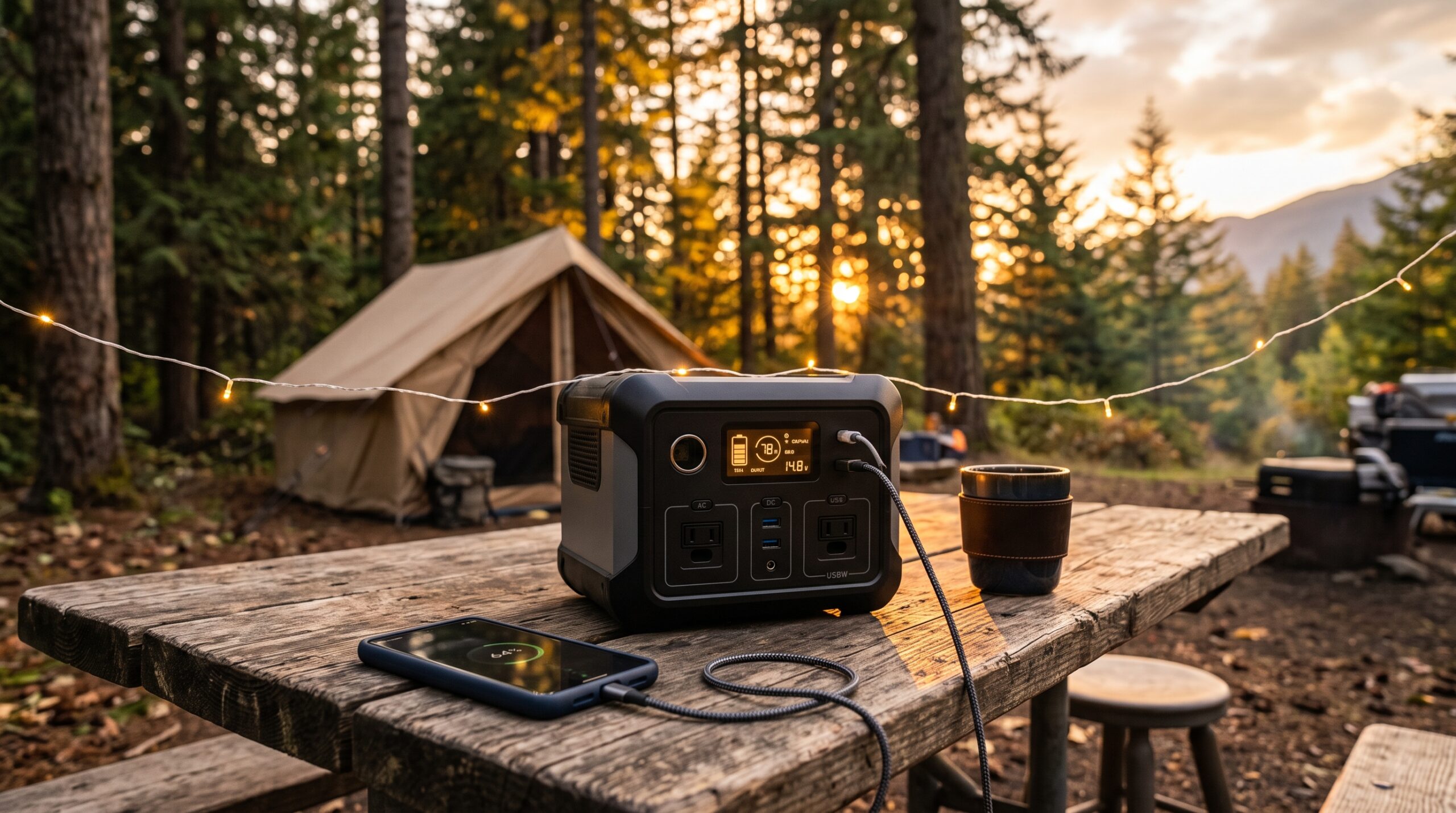
If you’ve ever been two days into a camping trip with a dead phone, a lifeless Bluetooth speaker, and no way to recharge your headlamp batteries, you already know why portable power stations have become essential camping gear. These compact battery packs give you reliable electricity at your campsite — enough to charge devices, run LED lights, power a mini fridge, or even brew a cup of coffee with a small electric kettle.
Unlike noisy, fume-spewing generators, portable power stations run silently and produce zero emissions. They charge from a wall outlet before you leave home, from your car on the drive out, or from a solar panel once you’re at camp. We researched the top-reviewed models from trusted outlets like Wirecutter, Outside, and OutdoorGearLab to find the best options for every type of camper and budget.
What to Look for in a Camping Power Station
Before you pick one, here’s what actually matters:
- Capacity (Wh) — Measured in watt-hours. A 300 Wh unit can charge a phone about 20 times or run a small fan for several hours. For running a 12V cooler overnight, look for 500 Wh or more.
- Output wattage — This determines what you can plug in. A 300W output handles phones, lights, and laptops. To run a blender, coffee maker, or portable heater, you’ll need 1,000W+.
- Weight — Ranges from 7 lbs (small units) to 30+ lbs (high-capacity). Match this to how far you’ll carry it from your vehicle.
- Port variety — Look for a mix of AC outlets, USB-A, USB-C, and 12V car ports. USB-C with Power Delivery is especially useful for fast-charging phones and laptops.
- Battery chemistry — LiFePO4 (lithium iron phosphate) lasts 3,000+ charge cycles vs. about 500–800 for standard lithium-ion. It’s the better long-term investment.
- Charging speed — Some models recharge in under an hour from a wall outlet; others take 6+ hours. If you’re heading out on short notice, fast charging matters.
1. Jackery Explorer 300 — Best Lightweight & Budget-Friendly
If you mostly need to keep phones charged, run a few LED lanterns, and maybe power a small fan, the Jackery Explorer 300 does the job without weighing down your gear pile. At just 7.1 pounds, it’s genuinely portable — you can carry it in one hand from your car to a campsite without breaking a sweat.
The 293 Wh capacity and 300W output are enough for personal electronics and small devices. You get two AC outlets, a USB-C port, and two USB-A ports. It won’t run a mini fridge or anything with a heating element, but for a weekend trip where you just need to stay connected and keep lights on, it’s perfect. The compact 9 x 5 x 8 inch size tucks easily into a gear bin.
At around $250, it’s also the most affordable option on this list. If you’re new to portable power stations and want to try one without a big investment, start here.
2. EcoFlow RIVER 2 Pro — Best Overall for Car Camping
The EcoFlow RIVER 2 Pro hits the sweet spot that most car campers are looking for — enough power to run real appliances, light enough to carry from the car, and priced below the premium tier. It was Wirecutter’s top pick for 2026, and after comparing it against the competition, it’s easy to see why.
With 768 Wh of capacity and 800W of continuous output (1,600W surge), you can run a 12V cooler, charge a laptop multiple times, keep all your devices topped off, and still have juice left for your camp kitchen gadgets. It weighs about 17 pounds — substantial but manageable. The X-Boost feature lets it handle some devices up to 1,600W by managing voltage, though heavy-draw appliances may run at reduced efficiency.
Charging is remarkably fast — the RIVER 2 Pro goes from 0 to 100% in about 70 minutes from a wall outlet. That’s a game-changer if you decide on a last-minute camping trip. It also supports solar input up to 220W. The LiFePO4 battery is rated for 3,000+ cycles, so this unit should last for years of regular use.
3. Anker SOLIX C1000 Gen 2 — Best Value for Multi-Day Trips
When you’re heading out for a long weekend or a full week of camping and need a power station that won’t quit, the Anker SOLIX C1000 Gen 2 delivers an impressive combination of capacity, output, and price. OutdoorGearLab rated it among the best performance-per-dollar units available.
The headline specs are strong: 1,056 Wh of capacity and a beefy 2,000W continuous output at 25.2 pounds. That’s enough to run a portable electric cooler, charge laptops and phones for days, power LED string lights for evening ambiance, and even handle a small electric kettle. The 2,000W output puts it in a class above most similarly priced competitors.
It recharges quickly — about 58 minutes from a wall outlet — and supports up to 600W of solar input for extended off-grid stays. The LiFePO4 battery chemistry means 3,000+ cycle longevity. One trade-off: the cooling fan can be audible during heavy loads, and this Gen 2 model dropped the expansion battery port from the original. But for the price-to-performance ratio, it’s hard to beat.
4. Bluetti Elite 100 V2 — Best Compact High-Capacity
The Bluetti Elite 100 V2 packs a full 1,024 Wh of capacity into a unit that’s notably more compact than most competitors at this level. Popular Science called it “arguably the best portable power station in its class,” and the combination of capacity, output, and build quality makes a strong case.
With 1,800W of continuous output (3,600W surge), it handles serious appliances — coffee makers, portable heaters, hair dryers, and anything else you’d normally need a generator for. Despite that power, it runs remarkably quietly at about 30 dB (quieter than a whisper). It recharges from a wall outlet in roughly 70 minutes, which is impressively fast for a 1 kWh unit.
At around 25 pounds, it’s similar in weight to the Anker C1000 but with a more refined form factor. The app connectivity lets you monitor battery levels and manage output from your phone, though the app can be a little glitchy. For campers who want serious power without the size and weight of the larger units on the market, the Elite 100 V2 is a standout pick.
5. Goal Zero Yeti 1500X — Best for Rugged Adventures
Goal Zero has been in the portable power game longer than most of these brands, and the Yeti 1500X shows that experience. It’s built like a tank — the kind of power station you’d trust on a bumpy off-road drive to a remote campsite or a dusty desert overlanding trip. Outside magazine selected it as their top pick for rugged adventures in 2026.
The 1,516 Wh capacity is the largest on this list, and the 2,000W output handles anything short of a full-size air conditioner. It has a comprehensive port selection including two AC outlets, two USB-C ports (one 60W), two USB-A ports, a 12V car port, and two 6mm DC ports. The build quality and weather resistance are a clear step above the competition.
The downsides? It’s heavy at 43 pounds, it charges slower than the EcoFlow and Anker units (about 4 hours from a wall), and the price tag is around $2,000. This is a premium choice for serious outdoor enthusiasts who need a bulletproof power source. If you’re looking for something to pair with a rooftop tent setup or an extended gadget-heavy campsite, the Yeti delivers peace of mind that cheaper units can’t match.
Quick Comparison
| Model | Capacity | Output | Weight | Best For |
|---|---|---|---|---|
| Jackery Explorer 300 | 293 Wh | 300W | 7.1 lbs | Budget / Light use |
| EcoFlow RIVER 2 Pro | 768 Wh | 800W | ~17 lbs | Best overall |
| Anker SOLIX C1000 Gen 2 | 1,056 Wh | 2,000W | 25.2 lbs | Multi-day value |
| Bluetti Elite 100 V2 | 1,024 Wh | 1,800W | ~25 lbs | Compact high-power |
| Goal Zero Yeti 1500X | 1,516 Wh | 2,000W | 43 lbs | Rugged / Premium |
The Bottom Line
For most car campers, the EcoFlow RIVER 2 Pro is the sweet spot — it’s powerful enough for real campsite needs, charges incredibly fast, and won’t break the bank. If you’re on a tight budget or only need to charge small devices, the Jackery Explorer 300 is a great entry point. For extended trips where you need to power a cooler and multiple devices for days, step up to the Anker SOLIX C1000 Gen 2 for the best value in the 1 kWh class.
Whatever you choose, pair it with a solar panel for true off-grid freedom. Most of these models accept solar input, which means you can keep them topped off without ever needing a wall outlet. That’s the kind of energy independence that makes camping feel less like roughing it and more like living well outdoors.
No responses yet