
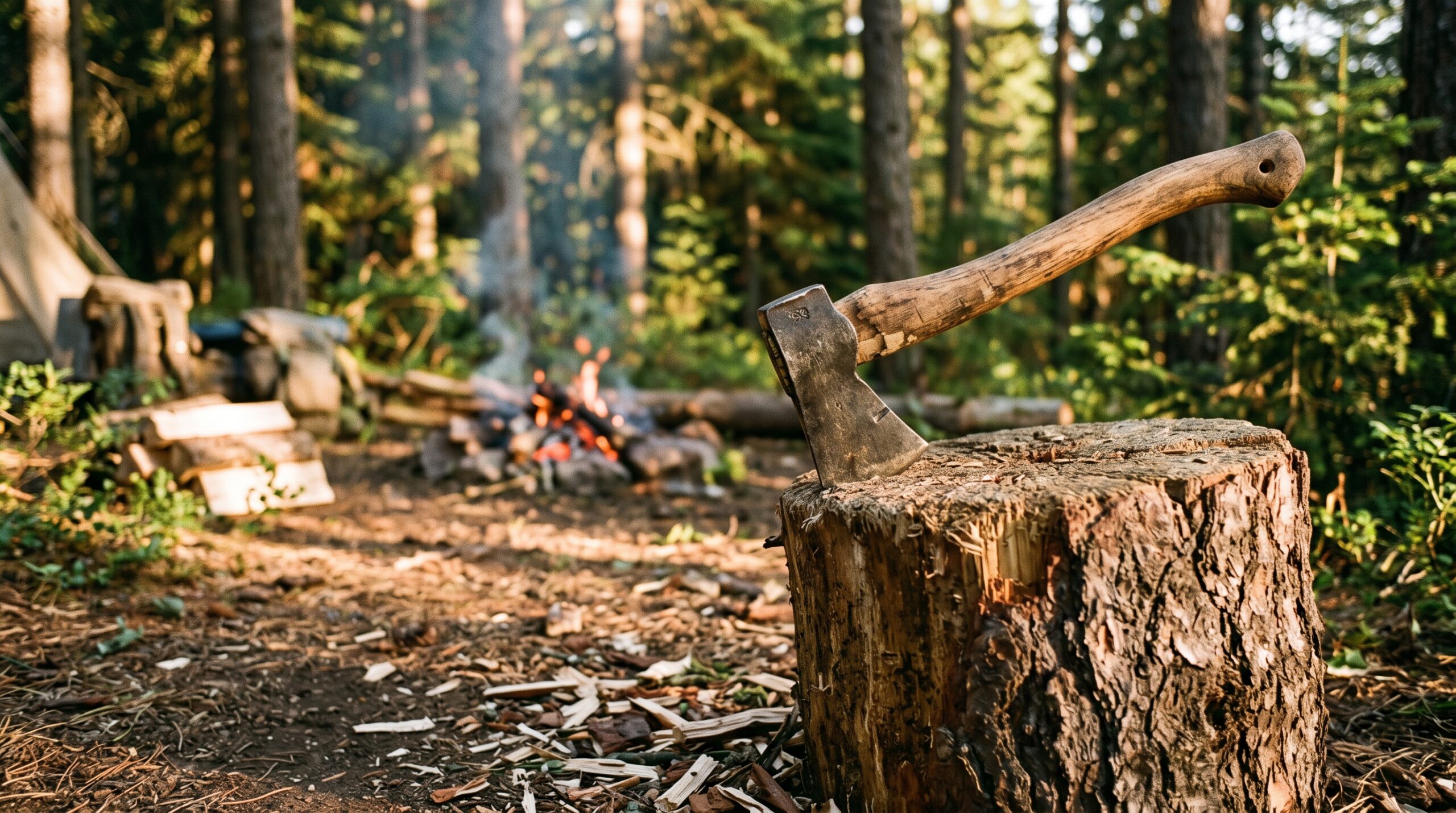
If you’ve ever tried to start a campfire with nothing but a pocket knife and determination, you already know — a good hatchet changes everything. It turns a frustrating hour of snapping twigs into a satisfying ten minutes of splitting kindling, processing firewood, and getting the fire roaring before the kids start asking “when’s dinner?”
But not all hatchets are created equal. Some are too heavy for the trail, some can’t hold an edge, and some look great on a shelf but fall apart after a weekend in the woods. We dug into expert reviews and hands-on testing data to find the camping hatchets and axes that actually deliver. Here are our five top picks for 2026.
What to Look for in a Camping Hatchet
Before you grab the first hatchet you see, here’s what actually matters:
- Weight and length: A typical camping hatchet runs 12–18 inches with a 1.5–2.5 lb head. Shorter and lighter is better for backpacking; a longer handle (24–28 inches) gives you more splitting power for car camping. Match the tool to your camping style.
- Head material: Forged carbon steel is the gold standard — it holds an edge well and sharpens easily. The trade-off is it can rust, so you’ll want to dry it off and hit it with a light coat of oil after use.
- Handle material: Hickory is the traditional choice — it absorbs shock, feels great in the hand, and can be replaced if it breaks. Composite (fiberglass) handles are more weather-resistant and lower maintenance but transmit more vibration and are harder to repair in the field.
- Edge geometry: Thinner bits are better for carving and limbing; wider, more wedge-shaped heads split wood more efficiently. Think about what you’ll actually use it for most.
- Sheath: A good sheath protects the edge, your pack, and your fingers. Some great hatchets ship without one (looking at you, Council Tool Flying Fox), so factor that cost in.
1. Fiskars X7 Hatchet — Best Budget
If you’re just getting into camping and don’t want to spend a fortune, the Fiskars X7 is the hatchet to start with. At around $35, it punches well above its price point.
The X7 comes sharp out of the box — sharper than many hatchets costing three times as much. The composite handle is virtually indestructible and doesn’t need the oiling and care that hickory does, which is great if you’re the type who tosses gear in the truck and forgets about it until next trip. It’s lightweight at about 1.4 lbs total, making it easy to pack.
The trade-offs are real but manageable: the composite handle doesn’t absorb shock quite like wood does (you’ll feel more vibration on big chops), and it can’t be replaced if it cracks. But for processing kindling, splitting small rounds, and general campsite woodwork, it’s remarkably capable. There’s a reason the Fiskars X7 shows up on nearly every “best budget” list — it just works.
Key specs: ~14″ overall · ~1.4 lbs · Composite handle · Coated carbon steel head · Includes sheath
2. Gerber Bushcraft Hatchet — Best All-Around
The Gerber Bushcraft is the do-everything camping hatchet. It chops, it splits, it hammers tent stakes, and it does all of it in the rain without complaining. If you want one hatchet that handles every campsite task, this is it.
The 1055 carbon steel head is coated for corrosion resistance, so it’s more forgiving than bare carbon steel if you forget to dry it off. The synthetic handle has an angled grip that helps with control and reduces shock — it feels noticeably more comfortable than cheaper composite handles. The flat poll (the back of the head) works as a hammer for tent stakes and campsite repairs.
GearJunkie rated it 7.8/10 after extensive field testing and highlighted it as their top bushcraft pick. At around $70, it sits in a sweet spot between budget tools and premium hand-forged options. It’s not going to win any beauty contests against a Swedish-forged hatchet, but it’ll be the tool you actually grab every trip because it just works in every condition.
Key specs: ~15.5″ overall · ~2 lbs · Synthetic handle · Coated 1055 carbon steel head · Includes sheath
3. Council Tool Boy’s Axe — Best for Splitting Wood
Here’s a truth most hatchet guides won’t tell you: if your main job is splitting firewood, a hatchet is the wrong tool. You want a camp axe — something with a longer handle and a heavier head that gives you real leverage. The Council Tool Boy’s Axe is that tool.
With a 28-inch hickory handle and a 2.25 lb head, it has dramatically more splitting power than any hatchet. It can handle medium-sized rounds that would have you swearing at a 14-inch hatchet. The Dayton-pattern head is a classic American design — it’s excellent for limbing, processing campfire wood, and even light felling work if you need to clear a small tree from a campsite.
Council Tool manufactures in North Carolina with American steel and hickory, and their quality control is solid for the price (around $60). The hickory handle absorbs shock well and can be replaced if it ever breaks. Just be aware that at 28 inches, it’s a car-camping tool — you wouldn’t want to strap this to a backpack.
Key specs: 28″ overall · ~3.5 lbs total · Hickory handle · 2.25 lb forged steel head · Sheath sold separately
4. Council Tool Wood-Craft Camp Carver — Best Lightweight
For the camper who wants a traditional American-made hatchet without the premium Scandinavian price tag, the Council Tool Wood-Craft Camp Carver is a gem.
It’s compact and light enough to pack on a backpacking trip or toss in a day bag, yet the balance and edge geometry make it genuinely useful for kindling, feather sticks, carving tent stakes, and light campsite work. Outdoor Life praised its versatility — it handles tasks from splitting small rounds to hammering stakes. The forged steel head holds an edge well and sharpens easily in the field with a simple puck.
At around $55, it occupies interesting territory: more refined than the Fiskars X7 (with a proper hickory handle and better balance) but far less expensive than hand-forged Scandinavian hatchets. It’s the kind of tool that doesn’t look flashy but earns its spot in your gear bin through quiet competence.
Key specs: ~16″ overall · ~1.75 lbs · Hickory handle · Forged 1060 carbon steel head · Includes leather mask
5. Hults Bruk Hultan — Best Premium
If you’re the kind of camper who buys gear once and keeps it for decades, the Hults Bruk Hultan is worth every penny of its roughly $199 price tag.
Hand-forged in Sweden (Hults Bruk has been making axes since 1697), the Hultan is in a different league from mass-produced hatchets. The balance is exceptional — the head feels like a natural extension of the handle rather than a weight you’re fighting to control. The hand-ground edge bites into wood with precision. GearJunkie rated it 8.8/10 after testing more than 30 hatchets over five years, making it their top overall camping hatchet pick.
The American hickory handle absorbs shock beautifully and can be replaced when it eventually wears (though that might be a decade or more with proper care). The vegetable-tanned leather sheath is included and fits perfectly. This is an heirloom tool — the kind of hatchet you pass down to your kids along with a love of camping.
Is it worth four to five times the price of a Fiskars X7? For weekend warriors, probably not. But for serious campers who use a hatchet frequently and value the craft, it’s an investment that pays dividends in performance, satisfaction, and longevity.
Key specs: ~16″ overall · ~1.75 lbs · Hickory handle · Hand-forged Swedish carbon steel · Includes leather sheath
Safety Tips Worth Remembering
A hatchet is one of the most useful tools you can bring camping — and one of the most dangerous if you get careless. A few rules that experienced campers live by:
- Always use a chopping block. Never chop against the ground, a rock, or — heaven forbid — while holding the wood in your other hand. A solid log section makes every swing safer and more effective.
- Clear your swing arc. Before every chop, check above and behind you. Tree branches, tent guy lines, and curious kids are all things you don’t want to hit mid-swing.
- Keep it sharp. A dull hatchet is more dangerous than a sharp one because it bounces and glances instead of biting into the wood. A quick touch-up with a sharpening puck before each trip takes two minutes.
- Sheath it immediately. When the hatchet isn’t in your hand, it should be in its sheath. No exceptions, no “I’ll do it in a minute.” Bare edges in camp are accidents waiting to happen.
Which One Should You Buy?
Here’s the short version: the Fiskars X7 if you’re on a budget or just starting out, the Gerber Bushcraft if you want one hatchet that does everything well, the Council Tool Boy’s Axe if splitting firewood is your primary task, the Council Tool Camp Carver if you want traditional quality without the premium price, and the Hults Bruk Hultan if you’re ready to invest in a tool you’ll keep for life.
Whatever you choose, a solid hatchet makes campfire prep faster, more efficient, and honestly more fun. There’s something deeply satisfying about splitting a round of oak with a single clean swing while the campfire crackles nearby.
No responses yet